T-shirt Design - Rock Roll Baby: Integrating Vector Assets into Your Creative Workflow
In the fast-paced environment of digital design and print-on-demand businesses, efficiency often dictates success. The transition from a conceptual idea to a tangible product requires a seamless workflow that minimizes friction and maximizes quality. This is where T-shirt Design - Rock Roll Baby serves as more than just a graphic; it acts as a critical component in your production pipeline. Designed with versatility and precision in mind, this asset bridges the gap between creative vision and technical execution, allowing professionals and hobbyists alike to focus on strategy rather than troubleshooting file compatibility.
Understanding the Asset Within the Production Chain
The core value of T-shirt Design - Rock Roll Baby lies in its structural integrity. Unlike raster-based images that degrade when scaled, this design is constructed using 100% vector shapes. This distinction is fundamental for anyone managing a workflow involving multiple print sizes or varying fabric types. When you integrate this design into your project, you are utilizing a scalable architecture that maintains crisp edges regardless of whether the final output is a small pocket logo or a large back-print.
The inclusion of a README.txt file containing all instructions and font links demonstrates a commitment to organizational clarity. In a professional setting, missing assets like fonts can halt an entire production run. By providing these resources upfront, the design eliminates a common bottleneck. It ensures that the typography remains consistent across different machines and software versions, preserving the intended aesthetic without requiring manual reconstruction or licensing negotiations.
Technical Specifications and Compatibility
For designers working across various platforms, file format flexibility is non-negotiable. T-shirt Design - Rock Roll Baby addresses this by including AI 10, EPS 10, PDF, SVG, and PNG Transparent 300dpi files. Each format serves a specific stage in the lifecycle of a garment:
- AI and EPS 10: These native Adobe formats are ideal for the initial editing phase. They allow you to manipulate individual vector shapes, adjust kerning, or reposition elements before sending the file to a printer.
- SVG: Perfect for web-to-print workflows or digital mockups where lightweight, resolution-independent graphics are required.
- PNG Transparent 300dpi: This high-resolution raster file is ready for direct printing on DTG (Direct-to-Garment) machines or for use in marketing materials where transparency is essential.
- PDF: A universal standard for communication with external vendors who may not have access to proprietary Adobe software.
This comprehensive package ensures that the design fits seamlessly into existing toolsets, whether you are using industry-standard desktop applications or cloud-based design platforms.
Adaptability for Dark Garment Workflows
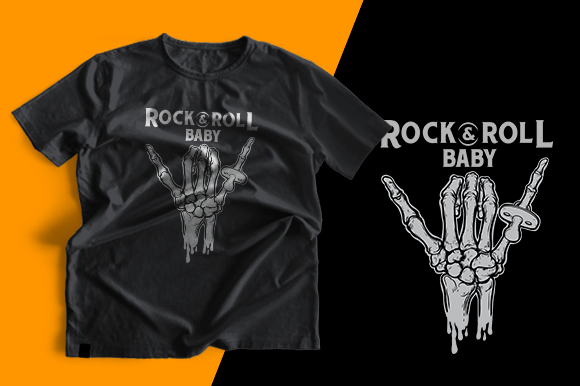
One of the most significant challenges in apparel design is color management, particularly when working with dark t-shirts. Standard designs often require complex underbase layers or color inversion processes that can be time-consuming and prone to error. T-shirt Design - Rock Roll Baby simplifies this through its built-in capability for easy color changes specifically optimized for dark fabrics.
This feature allows creators to rapidly prototype variations without altering the underlying structure of the artwork. Whether you are running a test batch for a new collection or fulfilling a custom order for a client, the ability to swap colors instantly streamlines the decision-making process. It reduces the cognitive load on the designer, allowing them to visualize how different color palettes interact with black, navy, or charcoal garments before committing to a print run.
From a business perspective, this adaptability translates to lower overhead costs. You can offer a wider range of products without needing to purchase separate licenses for each color variation. The design becomes a modular element in your catalog, capable of adapting to seasonal trends or customer preferences with minimal effort.
Integration with Print Preparation Tools
When preparing files for commercial printing, consistency is key. The vector nature of T-shirt Design - Rock Roll Baby ensures that spot colors and CMYK separations remain accurate. Because the shapes are distinct and editable, you can easily isolate specific elements if a printer requests a separation adjustment. This interaction between the design file and the RIP (Raster Image Processor) software used by printing houses is crucial for avoiding misprints.
Furthermore, the transparent background provided in the PNG version facilitates quick placement within mockup generators. Marketing teams can overlay the design onto various garment photos to create social media content or e-commerce listings. This pre-production visualization helps stakeholders approve concepts faster, accelerating the go-to-market timeline.
Strategic Implementation in Creative Projects
Implementing T-shirt Design - Rock Roll Baby into a broader project involves more than just opening a file. It requires a strategic approach to asset management and brand consistency. For entrepreneurs and small business owners, the design represents a starting point for building a cohesive brand identity. The "Rock Roll" theme offers a versatile aesthetic that can be adapted for merchandise lines, event swag, or promotional campaigns.
Consider the workflow of a freelancer managing multiple clients. Instead of creating a unique design from scratch for every request, having a robust library of vector assets allows for rapid customization. You can take the base structure of T-shirt Design - Rock Roll Baby, modify the text or specific iconography, and deliver a personalized product in a fraction of the time. This efficiency directly impacts profitability, as billable hours are reduced while maintaining high-quality output.
Educators and bloggers focusing on design tutorials can also leverage this resource. The clear organization of vector shapes makes it an excellent case study for teaching principles of scalability, color theory, and file preparation. Students can deconstruct the design to understand how professional assets are layered and organized, providing hands-on experience with real-world industry standards.
Maintaining Quality Control and Long-Term Viability
Long-term projects demand assets that do not become obsolete. The use of standard formats like AI 10 and EPS 10 ensures backward compatibility, meaning the file will remain accessible even if software updates change over time. This foresight protects your investment and ensures that you can revisit and reprint designs years later without losing fidelity.
Quality control is further enhanced by the 300dpi resolution of the PNG files. This meets the strict requirements of most professional printers, eliminating pixelation issues that can ruin a print job. By adhering to these specifications during the planning phase, you avoid the need for last-minute rescans or upscaling, which often result in degraded image quality.
Optimizing the User Experience Through Organization
The inclusion of a README.txt file is a small detail that significantly impacts the user experience. In a chaotic workspace, finding the correct font link or understanding the layer structure can waste valuable time. This documentation acts as a guide, ensuring that the implementation process is smooth and error-free. It reflects a professional approach to asset delivery, where the creator anticipates potential hurdles and provides solutions in advance.
For teams collaborating on a project, clear documentation is essential. It allows multiple members to work on the same design without stepping on each other's toes. One team member might handle the color adjustments for dark shirts, while another focuses on layout integration, knowing exactly where to find the necessary components.
Conclusion: A Foundation for Execution
T-shirt Design - Rock Roll Baby is not merely a graphic waiting to be printed; it is a functional tool designed to enhance productivity and creativity. Its vector foundation, flexible color options, and comprehensive file suite make it an ideal choice for anyone looking to streamline their apparel design workflow. By integrating this asset into your planning and execution phases, you reduce technical barriers and focus on what matters most: delivering high-quality, impactful designs to your audience.
Whether you are a solo entrepreneur launching a new clothing line or a marketer coordinating a corporate event, the practical benefits of this design are evident. It supports a structured approach to creation, ensuring that every step from concept to final product is executed with precision. Embracing such well-organized resources is a hallmark of effective project management in the creative industries.